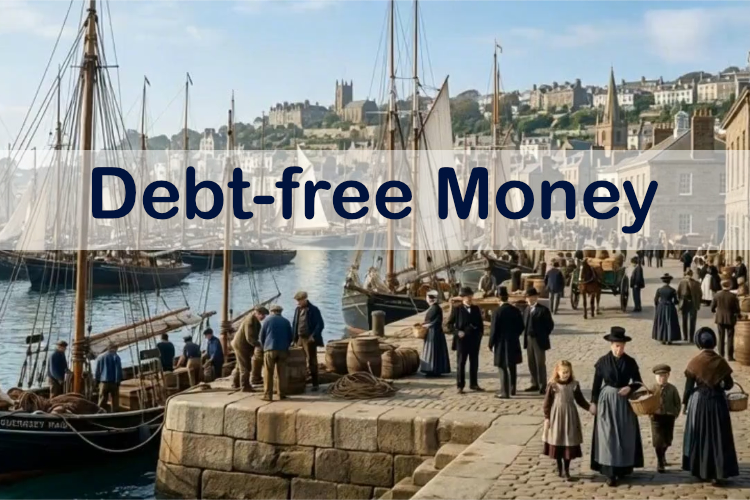
Historical proof that debt-free money is possible.
(click on the photo for the video version of this post)
reprinted from: https://archive.org/details/grubiak-the-guernsey-experiment-1992
INTRODUCTION
This world we inhabit is a prey to crazy contradictions. On the one hand, our scientific progress has been fantastic; with the splitting of the atom, thereby releasing the pent-up forces of the universe, new vistas have been opened out of such possibilities for mankind as even H. G. Wells could scarcely have foreseen. Possibilities of danger and painful extermination, no doubt - but should we avert the danger, a whole world of plenty and leisure could be ours for the taking.
A complete revolution in industry is already possible, by the use of automation. We are still, nevertheless, compelled to do dull and degrading work, which could easily be done by machines; no work, no wages. Our hankerings for security and the good things in life are translated into demands for full employment no matter how unnecessary. It is slightly unfashionable, nowadays, to refer to poverty in the midst of plenty, but alas, poverty is a terrible fact to our undernourished old-age pensioners, sick and poorly paid or unemployed workers. The gulf stretches unbridged between what we are, and what we could be! We have achieved mastery of the Earth, by taming the elements we have provided ourselves with mechanical robots, but we continue to endure poverty and slavery, in spite of all.
One would imagine that distributing wealth would be a simple matter, in comparison with the formidable task of producing it. Yet it is our distributing system, or money system, which is at fault. Although almost everybody, even the Government realizes our monetary system is quite out-of-date, nothing is being done about it. The Radcliffe Committee, set up to investigate monetary affairs, took two expensive years to confer, and its recommendations have been set aside. Naturally, the present financial system suits the people running it; those who control the purse strings control the nation. It suits the Banking System to keep their power by keeping money scarce. Certainly, with so many goods for sale in the shops, there is a strange shortage of ready cash. But for hire-purchase, personal loans etc., our economy would soon be on the rocks - it would founder on a surfeit of unsold goods. Debt, in the post-war world, is a common-place word. The whole nation flounders on debt, to the tune of untold millions. Considered calmly, however, this debt is only the reflection of our riches - the money loaned would be valueless, without a backing of goods and services. Surely, with all our brilliant economists, we could devise a system whereby money could be issued as required, without having resort to debt or usury?
It has been done, you know, in Austria! In a town called Worgl there stands a bridge whose plaque commemorates the fact that it was built by debt-free, locally created money. There was also a similar issue of money in Swanenkirchen in Bavaria. Both these towns were transformed temporarily from poverty-ridden to prosperous communities by this means, but both were forcibly prevented from issuing further money by their respective bank-controlled governments.
The Social Credit Government in Alberta was also prevented from issuing their own currency by the Bank of Canada and the Ottawa Government. The Alberta “Bill of Rights”, a masterpiece of creative policy, designed to give the citizens of Alberta complete and economic freedom, has been declared ultra vires. and summarily rejected by Ottawa.
So it is with pleasure and a certain relief that we now turn to the story of Guernsey that small but beautiful island well favoured by nature, in the quest for that most uncommon of human attributes, common sense.
CHAPTER ONE
FIRST STEPS TO PROSPERITY
At the beginning of the 19th Century, after the Napoleonic Wars, the Island of Guernsey was in dire straits. Apart from the natural beauty and pleasant climate, there was precious little else to attract visitors to the island, or indeed, to keep her inhabitants from removing to the mainland. The deep roads were mere cart-tracks, only 4 foot, 6 inches wide, which in wet weather became muddy rivers between steep banks. The town was ill-paved and unattractive, and there was not a vehicle for hire of any kind on the island. There was no trade, nor hope of employment for the poor. Worst of all, the sea was fast encroaching on the land, and was washing away large tracts of it thanks to the sorry state of the dykes. The States debt of 19,137 pounds bore an annual interest charge of 2,390 pounds but the annual revenue was only 3,000 pounds.
This meant that whilst vast sums of money were required to save the land from the sea. and make the island fit to live in, the net revenue from all sources was only 600 pounds per annum. This while the dyke project alone was estimated at over 10,000 pounds.
In 1815 the need for improving the Public Market, which then provided neither cover nor shelter, became felt, and a committee was duly appointed to examine the matter. It was found that further taxation on the impoverished Island was impossible. The alternative, that of borrowing money from the banks, would incur debt charges at a high interest rate, which they could not afford. It was abundantly clear that whatever they might borrow, although they paid interest charges for years, would never be repaid.
Finally, after grave deliberation, the Committee reported in 1816 with this historic recommendation - that property should be acquired and a covered market erected; the expenses to be met by the Issue of States Notes to the value of 6,000 pounds.
The arguments put forward at this time in favour of a States’ issue are interesting, as shown in this extract from the Committee’s report. The Committee recommends that the expense should be met by the Issue of States Notes of 1 pound Sterling to the value of 6,000 pounds, and that these notes will be available not only for the payment of the new market but also for Torteval Church, roads to construct, and other expenses of the States. When one considers that the banks already have their notes in circulation for more than 50,000 pounds, whereas it is now proposed to restrict the States’ Issue to a mere 6,000 pounds. There was also the argument that the Issue would provide a permanent revenue to the States, sufficient not only to provide for the erection of the market, but also to create an amortizement fund to extinguish the debt of the States.
These proposals. however. were not implemented until later in the same year, when the first issue of States’ notes was authorized for a sum of 4,000 pounds for coast prevention works, Torteval Church, and Jerbourg Monument. These notes were issued subject to redemption in three stages, April 1817, October 1817 and April 1818, and not for re-issue. The Committee’s report recommending the Issue states, In this manner, without increasing the State’s debt, it will be possible to finish these works, leaving sufficient money in the Exchequer for other needs.
It was not until 1820, after another abortive attempt in 1819, that the Committee were successful in their attempts to finance the building of a new market, and were at last given authority to Issue States Notes for this purpose to the value of 4,500 pounds, redeemable in 10 years out of import duties and the revenue from butchers’ shops. This issue was quickly followed by others, and in 1821 the number of notes in circulation was increased, on the Committee’s recommendation, to 10,000 pounds, as being the most advantageous method of meeting debts, from the point of view both of the public and the States finances. Indeed, the public seemed to realize this fact, and, far from being averse to taking the notes, they sought them out eagerly. The new markets were finally opened in October 1822.
In 1824, a further 5,000 pounds was authorized for the markets, and in 1826 the Issue was increased up to a total of 20,000 pounds to erect Elizabeth College and certain parochial schools. It was in this year, also, that the first States of Guernsey 5 pound notes appeared.
By 1829 the States’ Notes Issue in circulation exceeded 48,000 pounds, by 1837 over 55,000 pounds was the grand total. In the Billets d’Etat it was a frequent subject for congratulation; and it was stated over and over again by eminent men of those times that without the Issue of States’ Notes, important public works, such as roads and buildings, could not possibly have been carried out. Yet by means of the States’ issue, not only were these works accomplished, but the island was not a penny the poorer in interest charges. Indeed, the improvements had stimulated the flow of visitors to the island, and with increased trade the island enjoyed its new found prosperity.
CHAPTER TWO
TEMPORARY SETBACKS
IT IS a well-known, and true, saying that you can’t please everybody all the time, and this applied to the Guernsey States’ notes issue. Certainly, during the first ten years of the great experiment there was no opposition. In 1826, however, certain persons made representations to the Privy Counsel. and laid complaints that the States had no right to exceed their annual income without the Royal consent. An explanation was demanded by the Privy Council. and was supplied by the States Financial Committee to such good purpose that the matter was closed. Photostatic copies of this historic document have been kindly supplied by M. Guillemette, and a copy will be found in the appendix to this booklet for perusal by the serious student.
The real danger to the Guernsey experiment came from the quarter one could have expected - the two private banks on the island, namely the Old Bank, and the Commercial Bank (founded in 1827 and 1830 respectively). These private institutions simply flooded the island with paper money. The States, fearing that their own notes issue would be prejudiced if this continued, appointed a Committee to confer with the banks. Truth is stranger than fiction; what happened then is hard to understand, but the fact of the matter is that it was the States who eventually withdrew £15}000 of their notes from circulation, not the banks! In addition, the States had to agree to limit their issue in future to £40,000 No light can be shone on the reasons for this mysterious decision} as there are no records extant other than the bare facts. However, this agreement remained in force until 1914, when States notes in circulation valued £41,206.
During all this time, only one forgery had been attempted and, as it was very crude, it was immediately detected. As a result of this, it was felt necessary to withdraw the entire issue, which was replaced by a new issue of “greenbacks”.
CHAPTER THREE
FULL STEAM AHEAD!
So for over 70 years the position in Guernsey remained static, with a limited States’ Issue of 40,000 pounds. But in 1914 the Guernsey States were able to turn the tables on the private banks, and once more to issue money according to their own requirements.
The reason for this was the restriction imposed on the banks during the first World War - the demand for money was enormous, but the banks were prohibited from issuing more than the amount at that moment in circulation. The States, however, were under no such limitation, and they made such good use of their opportunity that by the end of the war, in 1918, the States’ Issue had risen to 142,000 pounds.
Since that time Guernsey has never looked back. Her Notes Issue has risen in measure with her prosperity, and in 1958 there was 542,765 pounds in circulation.
Now that the local Guernsey banks have amalgamated with English banking concerns, there are no longer any private bank notes on the island, but simply States Notes side by side with British Treasury notes.
Naturally, there is a greater demand for States Notes; no sane citizen of Guernsey wishes to have his taxes increased to pay debt charges! To enlarge on this theme: in 1937 the States Note money, about 175,000 pounds, cost the States only 450 pounds for printing and handling. A loan of the same dimensions would have cost about 11,383 pounds annually. So can you blame the Guernsey taxpayers for preferring their own money since, under their sensible and benevolent financial system they pay hardly any income tax?
During the entire experiment in Guernsey, from 1817 to date, there has at no time been a threat of inflation from the creation of States Notes. At all times, the States were very careful in the issue and cancellation of notes according to their ability and requirements. Any visitor to Guernsey is immediately impressed by the vast difference in prices between the island and the mainland of Britain. Thanks to the exceptionally low taxation and import duties, Guernsey enjoys low prices, plenty of money, and a high standard of living. In fact Guernsey can afford to leave worries about inflation to the debt-ridden mainland.
CHAPTER FOUR
CONTRASTS AND CONCLUSIONS
It is with reluctance that we leave the Island of Common Sense and return to the British mainland, but as this is a story with a moral and a lesson to be learned, the return must be made. What a contrast we find here - what a burden of debt to be paid by the long-suffering British citizen! Every year enormous rates and taxes have to be levied to pay for interest charges on debts that can never be repaid. The National Debt is now in the region of 28 billion pounds, and bears an interest rate, in 1960, of no less than 640 million pounds, which is double what we spend on National Health Insurance. Remember that of this sum collected from the taxpayers, only about one-fifth is returned in interest to private savers. The rest goes back to the banks, British and foreign.
It is easy to see, even if you are not mathematically minded, why we are still paying for the Battle of Waterloo. At 5 percent interest per annum, the interest paid on the National Debt is equivalent, after 20 years, to the original sum borrowed. Yet if our Parliament had come to the same conclusions in 1816 as the Guernsey States, and like them had issued their own money, what a different position we would now enjoy. Our National Debt would simply not exist and, as in Guernsey, our taxes would be negligible.
Thanks to the British Government policy, our Local Authorities are faced with financial problems which are well-nigh insoluble by orthodox methods. They are forced to borrow large sums at high interest, which can only be paid by constantly increasing tax rates.
One of the worst examples of debt-ridden communities can be found in Glasgow, with its local debt of over 167 million pounds. Every year enormous debt charges have to be paid out of the ratepayer’s pocket; in 1960, the figure is 9 million, 412 thousand pounds, or almost half of the total tax collected.
It is of Interest to compare certain figures in connection with the Glasgow Fruit Market, with those of the Guernsey Markets, already given. In Glasgow, the original Fruit Market in Candleriggs was built in 1817, and cost 60,000 pounds. This money was raised in conventional fashion, by an interest-bearing loan. Unlike Guernsey Markets, repaid 10 years after they were built, the Glasgow Markets were not repaid until 1956, 139 years later. We have been unable to obtain precise information about the total interest paid over the 139 years, however, it is on record that between 1910 and 1956 no less than 267 thousand, 886 pounds, were paid in interest alone.
No sooner has the debt been repaid than the necessity for scrapping this very expensive, but now obsolete, Fruit Market has arisen. In the Further Development Plan for Glasgow, the Fruit Market will be moved to a new site to relieve the present traffic congestion. It is as yet hardly possible to forecast the cost of this project, but between acquiring land, building and compensation, it may well be considered that the entire market will cost several million pounds. If this sum of money is raised in the usual manner, as an interest-bearing loan, the effects on Glasgow rate-payers will be doubly disastrous. Market rents will be sharply increased, probably trebled, which will put many small wholesalers out of business. Those who remain will be forced to recoup their additional expenses by increasing prices on goods sold, which will raise retail prices in Glasgow. Then there is the expense of the loan itself. It need hardly be pointed out that if an original loan of 60,000 pounds took 139 years to repay, a loan of several million pounds will be a burden on countless future generations of Glasgow citizens.
It can safely be assumed that every public work carried out on the financial basis of an interest-bearing loan, eventually costs the ratepayer almost three times its original cost. For instance, a house costing 2,000 pounds to build, will eventually cost 5,500 pounds.
So it is that every Local Authority in Britain, not just Glasgow, is in the same dilemma. To take another instance, Spitalfield Market in London proposes to spend 700,000 pounds on improvements. The tenants have agreed to have their rents increased to yield a total of 30,000 pounds - but at 5 percent interest, even the first year’s debt charge of 35,000 pounds will leave a deficit of 5,000 pounds to be added to the capital of the original loan. Each successive year will see the debt growing, instead of being repaid, as in Guernsey.
The new plan for Covent Garden, London’s fruit market and main distribution centre for this country, will cost 20 million pounds. When this new market begins to operate, rents will practically treble to meet the high interest charges on this loan. This will mean that distribution costs will rise throughout the entire country to meet the higher rents wholesalers will have to pay for their market stands.
The yearly revenues of the Guernsey Markets helped to build roads, harbours, schools, houses, etc., and to improve the island of Guernsey. The yearly losses of the Glasgow Markets, due entirely to debt charges, have come out of the Glasgow ratepayers’ pockets. It is noteworthy that during the blackest times of the depression in the ‘twenties and ‘thirties, Glasgow paid the highest interest charges.
Debt, private and public, is the cancer that preys on the vitals of our civilization, not only in Britain, but throughout the world. Many of our greatest thinkers have recognized this fact. Sir Mortimer Wheeler and Sir Compton Mackenzie, in their recent television programmes on Roman and Greek civilizations, have denounced high taxation and usury as main factors in the downfall of Rome and Greece.
Must we wait till our own great civilization follows its predecessors into limbo, or can we learn the lesson in time to prevent disaster?
The contrast between bankruptcy and prosperity, between negligible taxation and legalized robbery, in a word, between Guernsey and Britain, points the lesson. The flaw is in money creation. Guernsey creates its own money as a Credit, the so-called nationalized Bank of England creates our money as a Debt. Guernsey lit the torch of freedom from debt 130 years ago, and they are reaping the benefits in present prosperity. Guernsey leads the world in common sense finance. Shall we follow, or shall we continue to flounder ever deeper into the quagmire of debt, taxation, and final extinction? The decision is yours.