The Need for Debt
The most important reform needed to improve our economic system is never discussed. Without looking at the need for debt, a debt-based monetary system can’t be improved. What creates the need for debt in our economy? What alternatives could be used to replace it?
The idea that you must finance 100% of a major asset’s value upfront, before you can produce it, creates a massive need for debt. For example, few builders have enough in savings to pay the full cost of producing a new house. To acquire the necessary raw materials, services and labour of others they must borrow imaginary “promise-to-pay-back” credit from a lender who compounds the cost with interest.
But ask yourself. Instead of creating new imaginary upfront money using debt, why not have workers and suppliers create the money needed to drive production themselves, directly through productive contributions. Worker incomes should be created automatically by their labour contributions. Supplier transfers of raw materials and components should simply reassign existing values stored on lines-of-credit to different producers. No new debt would be necessary for producers at all. Businesses should be the custodians of worker created assets, not the owners of those assets. As assets move along a production chain, the custodians would change with each transfer. Without debt and interest costs, when assets finally move into retail markets, worker incomes would match prices exactly.
The idea that you must pay 100% of a major asset’s value upfront, before you can “own” it, creates another need for debt. For example, few people have enough in savings to pay the full price of a new house. To register a “Deed” of ownership most people must borrow imaginary “promise-to-pay-back” credit from a lender who compounds the cost with interest. This process repeats every time that major assets change hands, enriching lenders all over again.
But ask yourself, if money is created to represent the underlying value of assets, why should it be paid back to lenders and be extinguished any faster than at the actual asset depreciation rate. If a house is built to last 100 years, then repayment of the money created to represent that value should last 100 years. This of course doesn’t work when interest is charged on all money creation and loans. If 5% annual interest was charged on a 1 million dollar loan, amortized over 100 years, the total interest cost would be over 4 million dollars and the scam would be obvious. Setting maximum loan repayment periods to 20 years reduces total interest cost to under 600 thousand dollars, concealing the visibility of the extortion.
The more important question is why should the upfront payment of 100% of a major asset’s value be required at all. If the producers of the asset were all fully credited for their contributions to the asset’s production, then no money is owed to anyone, so there is no need to borrow at all. End users simply pay for the portion of the asset that they use and wear out. Depreciation and consumption rates are equal.
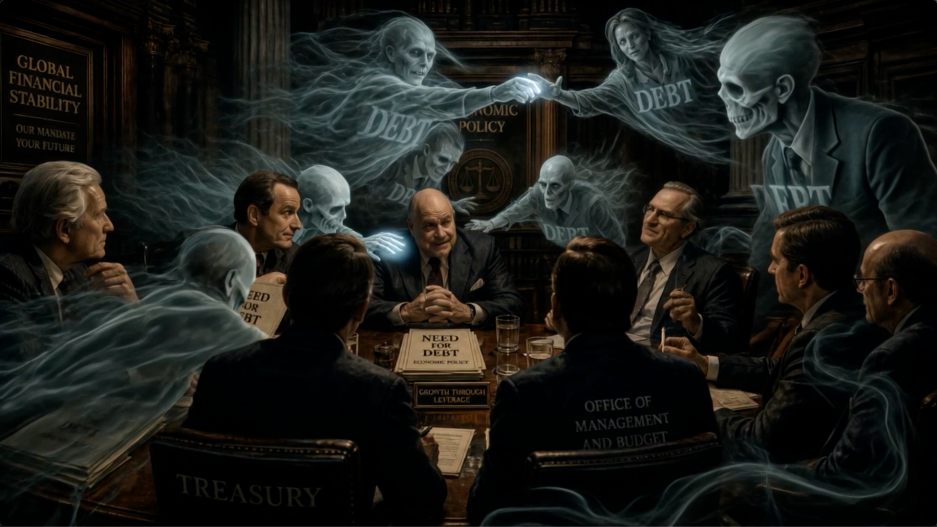
Society has been conned into believing an economic timing trick. The true purpose of the requirement to pay 100% of a major asset’s value upfront is to replenish a never ending need for the debt ghosts, that follow asset transfers from one “owner” to another. The real asset owners however, always remain, the debt holders.
Redefining Value
Before designing a better operating system for humanity we need to fully understand why there is a need for DEBT in the system we use now. This involves exploring the ether of social and economic VALUE. Ether is an invisible gas used to put people (and knowledge) to sleep.
I first saw the cracks in the foundation of society in the mid-1960s. Pollution and over-population were my main concerns. The anti-social design of our economic and monetary system was not revealed to me until the mid-1990s. I have been seeking solutions ever since.
VALUE is the core of society’s problems. Subjective, imaginary VALUEs drive our economy and define what is socially important. Economic or market VALUE is based on the “law” of supply and demand, or maximum self-interest, which sets prices at the highest level the market will bear. Prices have been completely separated from costs, which are protected “trade secrets”.
If all producers use prices to take in more FROM the marketplace than they pay out TO the marketplace in costs, then a shortage of money in the marketplace is inevitable. DEBT is society’s current means of ignoring this insanity. Imaginary promise-to-pay money is created out of nothing and loaned to the gullible fools who accept the nonsense that every asset must be paid for entirely, upfront, before it can be built or used. Interest demands back more than was loaned out which deepens and perpetuates the economic discrepancies further. DEBT simply pushes the promise-to-pay to the next generation.
As I point out in my videos, there are only two components to the REAL costs of everything that society produces… human and natural resources. Every product made is simply one format of storing a unique combination of the two resources. The tools and machinery used for resource extraction, automation, assembly and transportation are all simply stored versions of human and natural resources.
Creation provided the Earth’s natural resources for all living things both here now and yet to come. They are free. We don’t dump money into the ocean when we fish, or bury money in the ground when we mine minerals. We just take them from the commonwealth. The only costs are the human resource costs to extract and process the natural resources into usable assets. Realizing this is profound, because it reveals that human resources are the only true expense of everything made.
Human resources consist of knowledge, skill & talent, and physical labour. Knowledge is an accumulated social asset acquired over centuries of human existence. All new breakthroughs are merely extensions of previous thought. Intellectual property is a scam. Skill & talent are simply nature’s individual gifts nurtured through education, training and practice. No one can choose their natural talents before their birth. We must all, be thankful for, and make the best of what we have been given. If society VALUEs the social nutrition of individual potential, and the equal natural rights of every individual to live freely without coercion or exploitation, then the only ingredient left to measure the VALUE of everything is human labour.
Human labour occurs and is measured in time. Time is a universally understood standard that is fixed to the rotation speed of the Earth. Time is stable, constant and can’t be inflated by human desire. Time is universally and individually accessible and available to everyone equally. At some point in their life most people recognize that their time on Earth is limited and that it has infinite VALUE. What person when told they have only another month to live wouldn’t trade all of their material wealth and assets for another year of normal living. True respect for others includes respecting the infinite VALUE of their time as well. It naturally follows then that if all lifetimes are of infinite VALUE then all lifetimes are equally valuable to the individual. If all lifetimes are infinitely and equally valuable, then all increments of lifetimes, or hours, must also be of equal VALUE.
If prices are based solely on true costs, and the only true cost of all assets is human resources, then when automation reduces the need for human resources, the cost of everything decreases accordingly. This was the promise that was made when industrialization was first introduced. Modern methods would increase efficiency and lower the cost of everything. I’m still waiting for the price drops.

Time for Freedom
No matter what unit is used to set a price for society’s goods and services, each individual measures the product value subjectively by considering how long they would need to work to earn that price. Regardless of the unit of exchange, people already use time to measure value… so switching to a pricing system that measures value in increments of time would make a lot of sense.
Everything produced could be measured in time values quite easily. Labour costs would simply be the total contribution time of all workers along the chains of supply and production. Unequal income for identical working hours could be achieved using “paid rest” to compensate highly skilled or dangerous occupations. Higher salaries could be converted into hours by multiplying actual work times by the “paid rest” premium… so a professional with a “paid rest” premium of 200% who worked 8 hours would earn the 8 hours worked, plus 16 hours of “paid rest” for a total income of 24 hours. This amount would be input into prices.
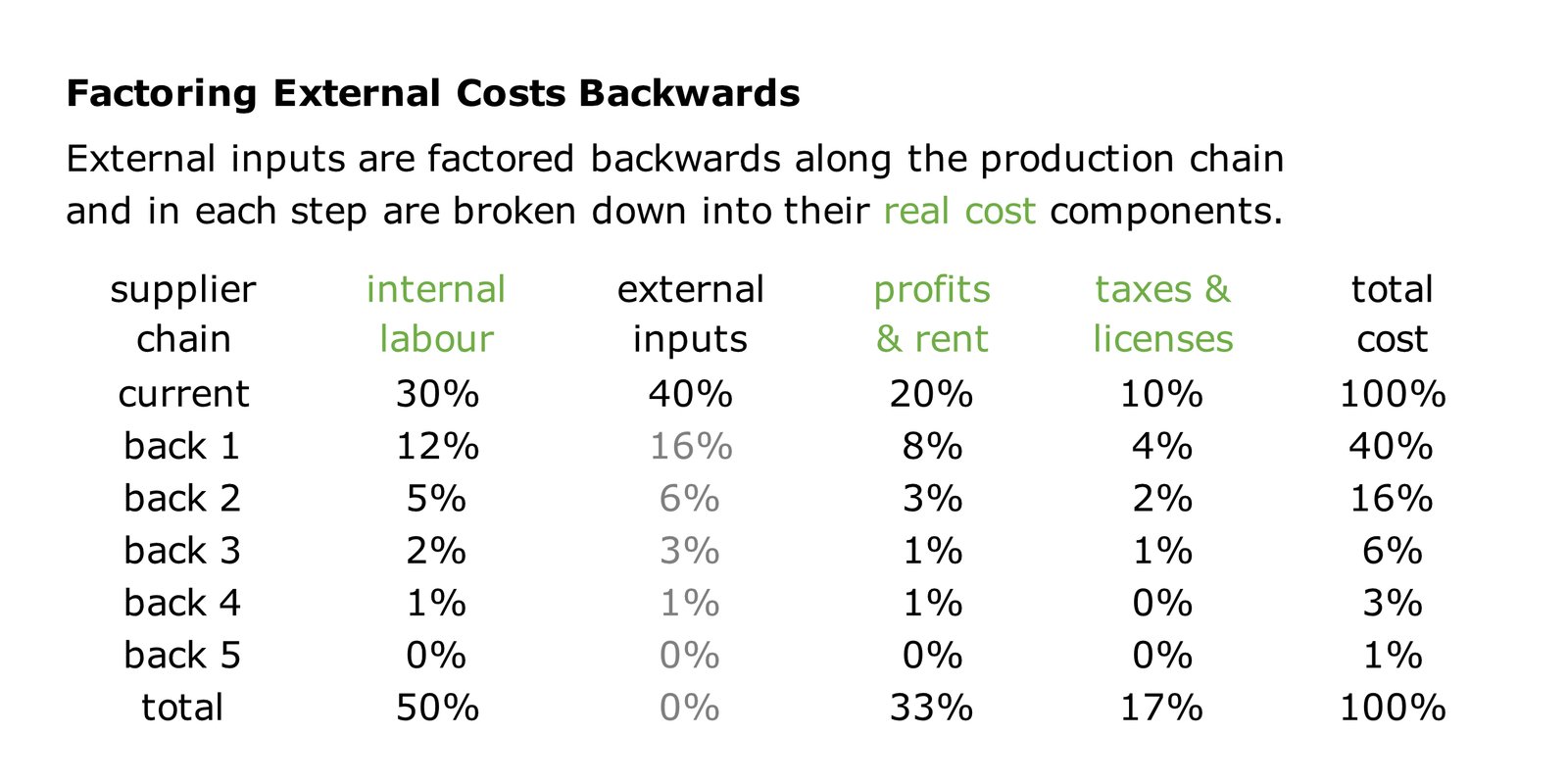
Now here is the fascinating part. When every other current supply and production cost is factored backwards to the original source of the component, only a labour cost exists. For example, if the current cost of a commercial building valued at $10M is broken down into its component costs, the construction company’s own internal labour might be 30%, another 10% may be professional fees, 40% might be raw materials, supplies and components, 10% may cover equipment rent and depreciation and 10% may be transportation, fuel, energy and utilities. Labour and professional fees were already covered in the previous paragraph. The 60% that remains for everything else can be broken down into the same combination of input costs. So 40% of the remaining 60% are labour costs, that’s 24% more added to the labour cost total, leaving only 36% left as other costs. These “non-labour” costs of the construction company’s suppliers can also be factored backwards to their own supply chains where 40% of that 36% (14.4%) was the labour cost to produce those production inputs. This brings the total labour cost now to 78.4% (40% + 24% + 14.4%). Factoring back each supplier’s own cost of purchased external goods and services adds another labour cost to the total and it should be obvious by now that when traced backwards to the source there is nothing except labour and natural resources in the whole supplier production chain network.
The only exception to this is the imaginary and arbitrary class of inputs that include profit, interest and taxation. A sound monetary and economic system will reject the legitimacy of these inputs. All three are simply an involuntary confiscation of individual property imposed by an institutionalized corporate/government oligarchy. There is no reason to allow extortion and graft in an honest money system. It is anti-social, anti-family and morally corrupt. An honest time-based money system would prevent these power tools of greed and violence from destroying Creation and the limitless value and potential of every living soul on the planet. Creation provided the Earth’s natural resources, our Common Wealth, as a free gift to all species both here now and yet to come, so the only true cost of everything made is human labour. This fact alone justifies why a sound economic system should measure value using time.
To help visualize what factoring backwards actually looks like, here’s a simple Excel file that factors external inputs backwards along a chain of production. For each step back, supplier external inputs are reallocated into their real cost categories using the current cost ratios. After excluding profits and taxes, internal labour is the only real remaining cost.